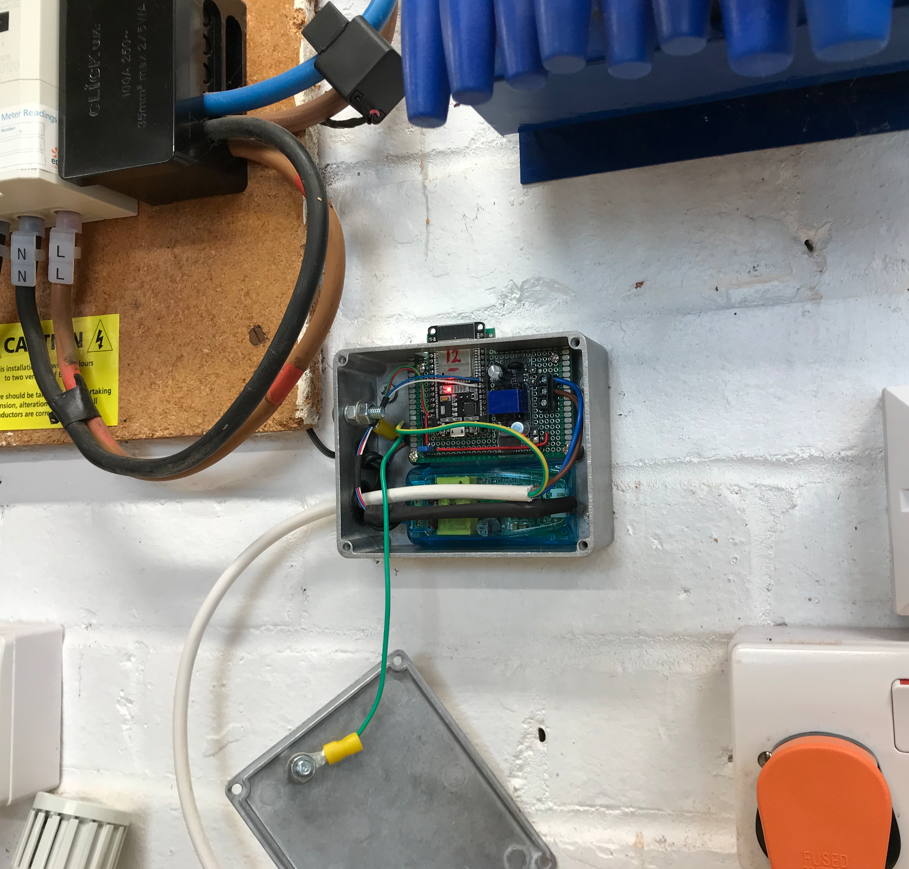
The next step was to cut out an apperture for the antenna on the ESP32 PCB to allow it to protrude properly from the diecast box. I also had to deal with all the other various
drillings in that box (for the earth M6 bolts, the two grommets, one large for the mains cable and a smaller one for the CT cable, the screws for the 10mm plastic
insulated stand offs supporting the ESP32 PCB and also a hole in the lid to ensure earthing continuity throughout the entire enclosure. You can see an orange mains
plug which is used to feed live and neutal to the monitor board (and which is fused with the smallest fuse I could get). Also if you look at the consumer board you'll
spot the CT clamp around the neutral tail heading out of the Henley box.
The design provides a reasonable degree of safety given the mains is physically issolated from the low voltage component - actually in two ways. The PZEM board is encased
and insulated. The mains wiring entering the choc block for that board is properly terminated with insulation up-to-but-not-touching the screw clamps. Regarding the
prototyping PCB, this has a number of rows of disconnected 0.1" pitch, sitting between the ESP32 and Buck board. I also fitted a 2nd plate of 2mm thick plastic immediately
under the buck board to act as an additional insulator (you can see that on the top picture). Low voltage wiring and high voltage wiring is double insulated where it crosses
and the entire enclosure (including lid) is earthed. This last point is important, as technically this is a class 1 device which must have CPC continuity to the enclosure.
The one remaining part to source is a clear plastic rectangular cap to sit on top of the ESP32 antenna - first and foremost to keep dust out but secondly to insulate
even that low voltage part of the board, just in case anything did go horribly wrong. I'll need to play with that to make sure I don't end up compromising signal strength
which is why, for now, I've left it off.
Note that the box is physically remote from the consumer unit. All communications occur over the air.