Blog 10th Jan 2020 – 14CUX EFi Engine fires but then immediately stalls Happy new year folks! Have you ever got into your car on a cold morning, turned the key and had the engine fire up nicely but then immediately stall? The back-story is that 10 years ago I retrofitted a Bosch 14CUX EFi fuel injection system to my elderly 1962 Land Rover running a petrol V8. All told, it has been very reliable with only fairly minor problems and provides good fuel economy and significantly lower emissions than its original twin carburettor setup. I fitted everything from the intake manifold up along with fuel system, the loom wiring, ECU and some other fabricated systems required to support the 14CUX including a dedicated home made telemetry system (microprocessor coupled with a small colour LCD touch screen) mounted just to the left of the dash. With this I can dynamically see some of the key values read from the ECU such as the engine speed, throttle position sensor, both temperature sender values (CTS and FTS), mass air fuel values and in real time (using two bar graphs) the signals from the two oxygen sensors in the exhaust pipes. My 14CUX tune resistor is a 3.9K and so the installation runs as a closed loop system defined as "Europe & UK 3.9 (or 3.5 Disco) with catalyst". In early November this year as the temperature was getting cooler I began my usual pre-winter service: oil level checks in the series III gearbox, transfer box, overdrive, swivel hubs, both differentials and steering box while also changing the engine oil and filter. After draining the 3.5 litre Rover sump and replacing the filter I generally like to fire the engine to make sure that the oil pump is properly primed (to move oil rather than air).
EFi Mass Air Flow Sensor (MAF)
On starting, the engine fired but then immediately stalled. A little puzzled, but guessing I'd done something silly, I disconnected the mass airflow sensor (MAF) sitting between the air cleaner and the plenum and which electrically measures the amount of air entering the engine and she started and ran just fine (see the explanation further down for why this may happen). By the end of the service, still feeling puzzled, I reset the ECU (to clear the previous missing MAF sensor fault) and the engine started and ran well. She continued to do so for the next couple of weeks. hmmmmm... a problem brewing!
Sure enough, two weeks later on a cold morning, the same fault returned with a vengeance. Starting her cold, turn the key... engine burst fires to around 1100 RPM (normal) but then immediately stalls. I could repeat this as many times as I liked but the engine stalled every single time. As during the service, if the MAF sensor was disconnected, the engine would start and run (not brilliantly, but well enough). I later found that if the engine ran for long enough to get the coolant up to around 60℃ the stalling fault cleared and she'd start and run perfectly from then on. After warming, if the engine was allowed to rest for (in one test) 4 hours when the coolant and fuel temperature sensors would report around 12℃ she'd still start quite reliably. But, if she was left overnight, the same fault would be guaranteed to reoccur... always affecting starting a stone cold engine with a closed throttle. Early on in my exploration of the problem I reset the ECU and swapped the MAF sensor with a stock spare that I'd bought many years ago on eBay, but the engine failed in exactly the same way. So clearly this fault wasn't being caused by the mass air flow sensor... or so I thought. Ok... so what is the likely cause? Well, any warm petrol engine needs air and fuel to be supplied close to an ideal ratio of 14.7:1 known as a stoichiometric mixture. For every 1 gram of fuel, 14.7 grams of air will be required for combustion. When an engine is cold, the mixture has to be made richer with more fuel to get it to run, not because the combustion characteristics change when cold (they don't), but simply because it is very much harder to convert raw fuel into vapour when an engine is stone cold. Instead of the fuel actually reaching the combustion chamber as vapour, it tends to pool on the walls of a cold manifold as a liquid. Consequently the engine needs more fuel to compensate. The 14CUX injection system gets fuel into the engine by spraying a fine mist of raw fuel using two banks of four injectors squirting directly into the eight intake ports of the engine. Air gets in via one of three possible routes. If the throttle is open, the lions share of the air passes through the air filter, through the mass air flow sensor (MAF), through the open throttle into the large plenum before being sucked into the engine along with the fuel. The ECU alters the amount of fuel injected by adjusting the open time of the two banks of injectors in order to correctly match the volume of air measured by the MAF - thus achieving stoichiometry. If the throttle is closed, air flow occurs via two dedicated subsystems both of which use a small portion of metered air from an opening in the throttle body just in front of the closed throttle blade... meaning that the ECU 'knows' how much air is being consumed by both of these subsystems. One of these two idle air supply subsystems known as the base idle system provides a calibrated, fixed amount of air at all times into the plenum (and then the engine). The user calibrates this by turning a screw (the base idle adjustment screw) located on the outside of the plenum (sometimes underneath an anti-tamper plug), close to the throttle blade, to control how much air can pass. The screw admits air into a roughly 6mm diameter bore drilled on the inside of the plenum and which exits on the engine side of the throttle blade. Once this path has been calibrated, the resulting air flow entering the engine is fixed and constant, but when compared to the amount of air entering via the throttle it is also rather small and only significant when the throttle is closed. Taken on its own, it should result in a warm engine idle speed of around 525 RPM. If normal idle is around 730 RPM then this path supplies something close to 72% of the air required for the idling engine. If you ever do remove the plenum from your EFi, make sure you unscrew the base idle adjustment and clean the path from start to finish as it does tend to get very gungy over time. The second idle air supply subsystem known as the Idle Air Control (IAC) system makes use of a stepper motor under control of the ECU acting like a variable air valve sitting between metered air from the MAF and the plenum chamber. The ECU opens the stepper motor to admit more air which makes the engine speed increase, or closes it to reduce the amount of air causing the engine to slow down. The MAF sensor will at all times measure how much air is being consumed (regardless of the position of the stepper motor) and so the ECU can always adjust the amount of injected fuel for stoichiometry. The ECU uses this subsystem to bring the idle speed to roughly 730 RPM for a warm engine and more for a cold engine. Whenever the engine is switched off the ECU terminates engine operation but waits until it detects that the engine has stopped. It then opens the stepper motor as far as it can, to maximize the idle air path in preparation for the next time the engine is started. You can actually hear this as a quiet buzz shortly after the engine dies. Cold starting process Cold starting works more or less as follows. The ECU starts the fuel pump and refers to the coolant and fuel temperature senders (CTS and FTS, which will both be sitting somewhere around 3℃ most mornings where I live) to figure out the fuelling map to use. These two temperature values are very important because starting a cold engine requires a very different fuel map to that required by a hot engine. If the sensors were misreporting then the engine would run badly assuming it ran at all and so both are important to check if you have a problem. As it happens, I can read both these values in degrees centigrade from my telemetry system which queries the ECU directly to see what values it is seeing and so I knew both were correct. As soon as the ECU sees slow pulses incoming from the distributor (8 per crank rotation) during slow engine cranking it starts injecting fuel (if it doesn't see those pulses within a second or so, the fuel pump gets turned off). Remember that at this point the IAC air path will be fully open as a result of the previous engine stop (or ECU reset). Assuming the engine fires, the wide open IAC air path coupled with the rich cold starting mixture immediately allows the engine to burst fire up to around 1000 to 1200 RPM, which the ECU detects when the distributor pulses suddenly increase in frequency. At that point the engine is running fast and rich. The next step for the ECU is to start reading the mass airflow sensor to figure out how much air the engine is consuming so that it can properly lean out the excessively rich starting mixture while at the same time lowering the fast idle speed by closing the IAC stepper motor. In our case, as soon as the ECU tried to lean out the mixture, the engine stalled. Why would disconnecting the MAF sensor consistently allow this engine to run? Well, whenever the MAF is disconnected (or electrically fails), the ECU detects the missing signal and switches into a special limp home mode, employing a fixed and rather rich fuel map. Without the MAF, the ECU has to guess air flow into the engine which it does using the throttle position sensor to read how wide the throttle is open. As it happens, the limp home fuel map works really well... something that the left and right bank O2 sensors on my telemetry system confirm. Being able to see these O2 sensor outputs as bar graphs on a colour LCD display is, arguably, the most important diagnostic tool you can have when assessing the overall health of a running 14CUX EFi system. What I found was that during part throttle cruise the limp home fuel map generated a mid point voltage on the sensors, but during deep throttle or WOT, the sensors would saturate rich... exactly what you'd want for a limp home mode. It is astonishingly good and easily good enough to get you home. Hats off to Bosch for the design. There's an additional diagnostic value to finding that limp home mode will run the engine while being able to see the O2 sensors... for if the engine does run, it pretty much confirms that the loom wiring, fuel pressure, injectors (at least most of them), throttle position sensor and both O2 sensors are all working well. Here's a video showing the proper operational characteristics for both O2 sensors in a 14CUX fuel injection system running at idle.
The fact that the engine would run with the MAF disconnected indicated it was perfectly capable of running so long as the mixture was fairly rich. We'd already done the MAF swap so I knew (actually, I thought I knew) that the MAF wasn't misreporting the mixture, suggesting to me that there must be an air leak somewhere in the induction system resulting in a lean running condition. I also knew that any air leak would likely have a disproportionately large effect whenever the engine was cold. This was my starting point. The whole induction system on an EFi engine is fairly complex and delicately balanced. The seals between all the components have to be spot on to avoid air leaks. All the various hoses, air filter, MAF, throttle body, plenum base, ram housing, intake manifold and even the O rings around the base of all eight fuel injectors all provide any number of ways air can get into the system. It is possible albeit slightly risky to identify air leaks by carefully spraying solvent around the joints and listening for a change in engine speed - but this test never once identified a problem. On this engine the V8 valley gasket sitting between the intake manifold and the block acts as an air seal between the intake manifold and the engine heads. It was an older style tin gasket, well over 6 years old and scabby and so I suspected there may be an air leak under the intake manifold that I couldn't get to. I also separately found some of the vacuum hoses supplying the brake servo, PCV system, dash gauge, fuel regulator and the distributor advance/retard source were a little perished - so an air leak was a very logical piece of reasoning... but as it happens, completely wrong. I will say that after two weeks rebuilding the entire induction system from scratch the engine looked delightful, but on the first cold start after all that work had been done, she burst fired and then immediately stalled. Oh joy! I then spent days looking at every conceivable cause of the problem... fuel system, fuel pressure, fuel regulator, electrical connections between the ECU and the various components and anything else I could think off, but no matter what I did, the engine would stall as soon as I tried to start it from cold. Checking the eight fuel injectors Here's a simple confidence check that the 8 fuel injectors are good and all you'll need is a pressure gauge on the fuel line between the filter and the injection rail. Switch the ignition to the run position (not start) at which point the fuel pump will buzz for a couple of seconds then switch off. Now have a look at the fuel gauge and you should see around 37 PSI. After a minute that should still be very close to 37 PSI, assuming all the injectors and the fuel regulator are sealing properly - that's part one of the test. If you now remove the electrical plug from the injector for say cylinder #1 and momentarily apply 12v to its terminals you'll be able to see the pressure on the gauge suddenly drop, confirming that that injector is opening and passing fuel into the cylinder. I repeated this test on all 8 injectors and even though it doesn't measure the precise amount of fuel flowing, it does nicely confirm that the injector is both opening and closing. Regarding the wiring to use for the above test, if you imagine you're leaning over the wing (fender), looking into the engine, place the ground wire on the left hand pin of each injector and momentarily brush +12v on the right hand pin in order to mirror what the ECU does. Also note that you won't be able to get to all 8 injectors depending on the orientation of your plenum. Mine has its throttle on the drivers side, which means you can't get to the injectors for cylinders 4 and 6. Regardless I was still able to test 6 injectors... and the other two were checked the next time the plenum was removed. Knowing that 6 out of 8 work, isn't bad. Checking the fuel pressure regulator If you're uncertain about what the fuel regulator does, here's what it should do - and all you'll need is a fuel pressure gauge in the fuel line between the filter and the injection rail. You'll need to be able to run the engine (even if in limp home mode). If the fuel pump has just run, but the engine is not yet started then the fuel pressure should be around 37 PSI and it should hold pretty close if you wait for a couple of mins (confirming that the injectors and the fuel regulator are maintaining their seals). Start the engine and let it idle. With the throttle closed, the fuel pressure should remain stable at around 34 PSI. At that point if you snap open the throttle, raising the engine speed to around 2500 RPM the fuel pressure will at the same time snap up to around 37 PSI but quickly return back to 34 PSI when the throttle is closed. From idling, if you were instead to very gradually open the throttle increasing engine speed to 2500 RPM, then the fuel pressure will stay quite close to 34 PSI and then slowly drop to around 28 to 30 PSI as the revs and fuel consumption increases. Remember as the engine vacuum increases, the fuel pressure should level out at around 34 PSI. If engine vacuum suddenly reduces (ie: whenever the throttle is blipped opened) then fuel pressure should increase to a high of around 37 PSI. If the fuel pressure behaves this way, you'll know the regulator is working. I did look online for a video showing what the fuel pressure should do on one of these systems, but without any luck... so here's a video that might help you. In this installation the gauge sits close to the engine between the fuel filter and the input to the fuel injection rail. It is shown working on a fully warmed idling engine driven by a 14CUX fuel injection system... consequently as the camera is buried in the engine bay there's a lot of noise... sorry. If I was to have switched the engine off, the pressure gauge would rise to 37 PSI and hold there, actually for a good couple of hours... all signs of a working pressure regulator and injectors that are properly sealing.
Another more involved way to test the fuel regulator requires access to one of those hand held vacuum pump tools. You need to hardwire the fuel pump to run permanently which is obviously much more dangerous if you do something wrong - so my advice is don't use this technique unless you know precisely what you are doing. Connect the hand held vacuum tool to the fuel regulator and then start the pump with zero vacuum. Pressure should be 37 PSI. Apply vacuum using the hand tool and the pressure should slowly reduce as you get closer to 15 to 20 inch mercury to around 34 PSI where it should sit. If the vacuum is suddenly released (simulating WOT) then the fuel pressure should snap up quickly to 37 PSI. Using temperature to pin this down In exasperation and with no clue what the problem was, I wondered if I could use temperature to pin the fault down - given that I knew the engine worked really well when fully warmed. For my first test I removed the ECU and kept it warm inside the house overnight, but I had exactly the same problem the following morning. My second test ran a heater inside the cab for a couple of hours, before trying to fire her up - but with no joy. Faced with a stalling engine and purely on a hunch I removed the MAF sensor from the cold car and stuck a hot air blower in front of it for 5 mins... after which, low and behold, she started perfectly.
In disbelief, I took both of my MAF's onto the bench and had a closer look using the test harness shown in the picture. MAF's employ a very simple four wire circuit. Three wires deal with the supply (ground, +12v) and the MAF air flow signal output voltage - which should sit between 0.2 and 0.7 volts with No Air Passing (what I call the NAPV - measured with plastic caps on both ends of the sensor body). A fourth wire is an input to the MAF and is set to a value by the ECU depending on the mode the 14CUX is running in (see tune resistor). If using catalytic converters, then this fourth wire will be 1.9v and it won't ever change. The ECU deals with this signal differently if the 14CUX is running in a different mode from mine, at which point an adjustment screw on the side of the MAF can be used to adjust CO2. With both my MAF units on the bench I found the following. The original MAF would generate a tiny 0.02v air flow voltage when cold but would suddenly burst into life and start outputting around 0.4v if a hot air blower was used to heat the body of the unit up to a typical engine bay temperature. Once it had switched into working mode, I could remove the two plastic caps, blow into the sensor and see a nice large signal swing up to around 4 volts. By contrast, the spare MAF that I'd used right at the start as a substitution test, was completely dead and didn't generate any air flow voltage regardless of the temperature.
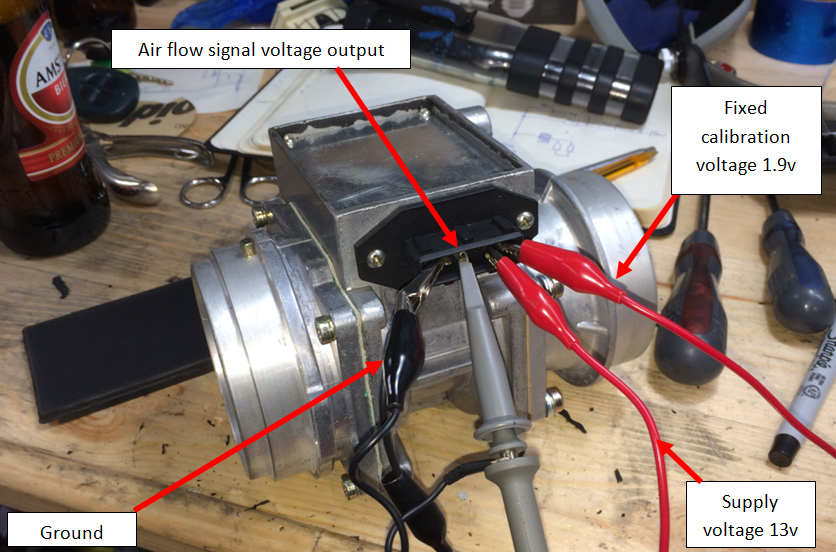
MAF Test Harness
The penny drops I'd never spotted the zero air flow voltage from this MAF - why? Every time I'd measured that voltage it had been in spec (0.3v upwards) but that can't have been the case when everything was stone cold, as my bench tests confirm. The only plausible explanation I can come up with is that I must have accidentally measured the voltage whenever the MAF had warmed sufficiently to burst into life. Swapping the MAF with our spare unit had also led me to incorrectly believe the MAF couldn't be the cause of the problem - but only because the first MAF generated no voltage when cold while the spare generated no voltage at all, because it was bloody dead. These two entirely unconnected faults happened to give rise to the same failure and so reinforced a wrong diagnosis. Yep, fault diagnosis by substitution is not always particularly reliable and tends to be very expensive. To make this even more bizarre, as my spare MAF was dead anyway, I removed the sealed plastic cover and the aluminium plate underneath to have a look at the PCB - and immediately found two dry joints on the legs of a TO220 Darlington transistor. Once those two faults were rectified, the unit burst into life on the bench generating a healthy 0.4v with no air passing. Blowing into the unit with the covers off showed a nice sharp signal swing up to around 4v. Feeling pleased, but understandably a bit uneasy, I ran the unit on a 24 hour test and spotted something interesting. As it warmed, the air flow output voltage slowly dropped to nothing if you waited long enough. Out of interest I popped this unit into the vehicle to see if it would eventually lean the engine out to the point she couldn't run as I knew full well I'd be able to get home by disconnecting the MAF (flipping into limp home mode). After leaving the MAF in the engine overnight (so it was stone cold) the engine started perfectly and I then took her for a long test run while keeping a close eye on the O2 sensors. After around 30mins the engine was running, but I noticed that both O2 sensors had stopped oscillating (meaning the engine was now running lean). By the time I'd reached 45 mins into the test, the mixture was so lean that the engine became undriveable, with pops in the intake confirming the problem. I pulled the MAF plug to revert to limp home mode and drove back immediately. So even after fixing the dry joint faults, this unit was failing anyway and in fact both units were exhibiting temperature failures. Later tests on the bench confirmed that it wasn't a component on the PCB causing the temperature failure - but instead the fault occurred when the aluminium body housing the hot wire sensor was heated. If you Google this type of problem, you'll generally get the idea that this will either be an air leak somewhere in the induction system or a faulty MAF, but I've read lots of comments suggesting MAF's mostly fail by going too rich (over reporting the amount of air entering a system). Well I've now seen three MAF's fail and all of them misreported air flow too low, causing the ECU to run the engine too lean. In my case, the only way to check for sensible operation was to stick the unit on the bench and make sure that the air flow output, measured with no air passing, doesn't drop to zero whenever the temperature changed. Faced with the same problem again I think I'd start by checking the fuel pressure to make sure I had around 34 PSI at idle rising to around 37 PSI when the throttle was blipped open. I'd check for any obvious air leaks (broken hoses) and I'd also cap off the feed to the brake servo to make sure that the diaphragm wasn't broken (unlikely but worth ruling out). I'd electrically buzz out the connections between the ECU, MAF and both temperature sensors (coolant and fuel) to make sure the loom was sound. Then (assuming I wasn't able to query the ECU directly) I'd measure the resistance of the temperature sensors when the engine was stone cold to make sure the resistances accurately reflected ambient temperature. Assuming no faults were found I'd disconnect the MAF, take it to the bench and measure the output voltage with no air passing when cold (using a fridge) and when warm (use a hot air blower). I'd be looking for a condition where the output voltage drops close to zero volts, at which point, bin the MAF and buy another. If I still couldn't find a problem, I might start looking for induction air leaks. I ordered a brand new MAF from Rimmer Bros (thanks guys) problem solved... and after all the faffing around and head scratching, well at least the engine looked rather splendid. Comment | Back to Quick Links...